
01-01 Honda Civic Through the Generations: How the Model Changed from the 1970s to 2025
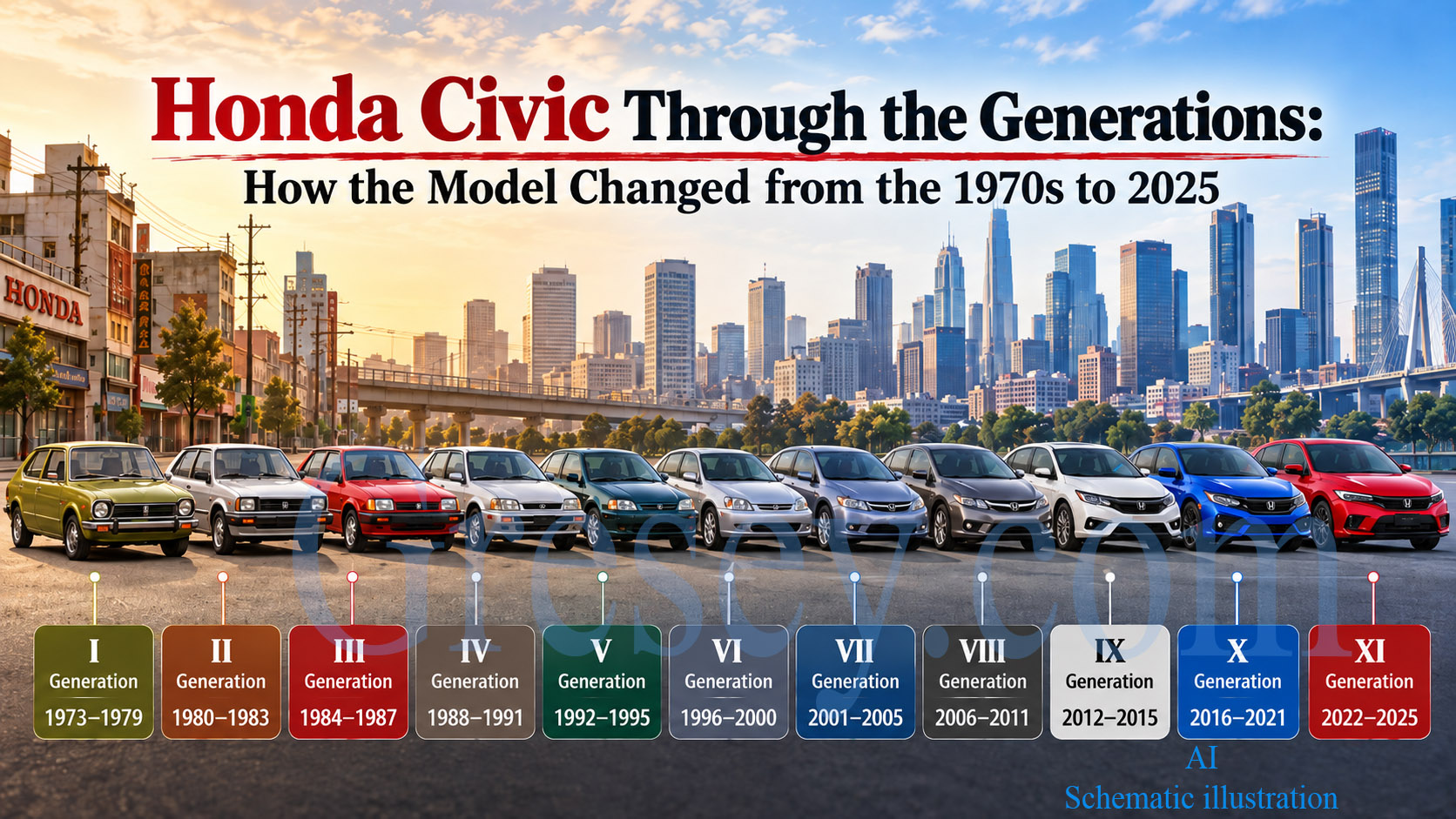
When Did the Honda Civic First Appear, and When Does the Model’s History Begin?

The first-generation Civic debuted in the United States at an ideal time for the model—during the 1973 fuel crisis. As gasoline prices soared and large American V8-powered cars became an unaffordable luxury, the tiny, fuel-efficient Japanese hatchback quickly went from an outsider to a major money-saver for American drivers. The history of the Honda Civic in the U.S. market begins with the 1973 model year. Honda’s official model chronology in the 2026 Digital FactBook identifies that year as the start of the Civic Hatchback’s North American history. Calendar years and model years should not be confused with generation changes. In the automotive industry, a new model year is often announced before the corresponding calendar year begins. For this reason, model years are the more appropriate reference when comparing Honda Civic vehicles.
At first, the Civic was a simple model line represented by a three-door Hatchback. New body styles, distinct technical directions, and separate branches appeared later. Some existed for decades, while others disappeared after several generations. The history of the Civic is therefore a gradual evolution of the entire model family. To understand the sequence of changes and transformations within the Honda Civic family, it is necessary to look beyond appearance and body styles. Engines and transmissions changed as well. The models received new chassis components, steering systems, braking systems, and other major vehicle assemblies. [HC25]
What Are Honda Civic Generations, and How Are Generation, Model Year, and Production Year Related?
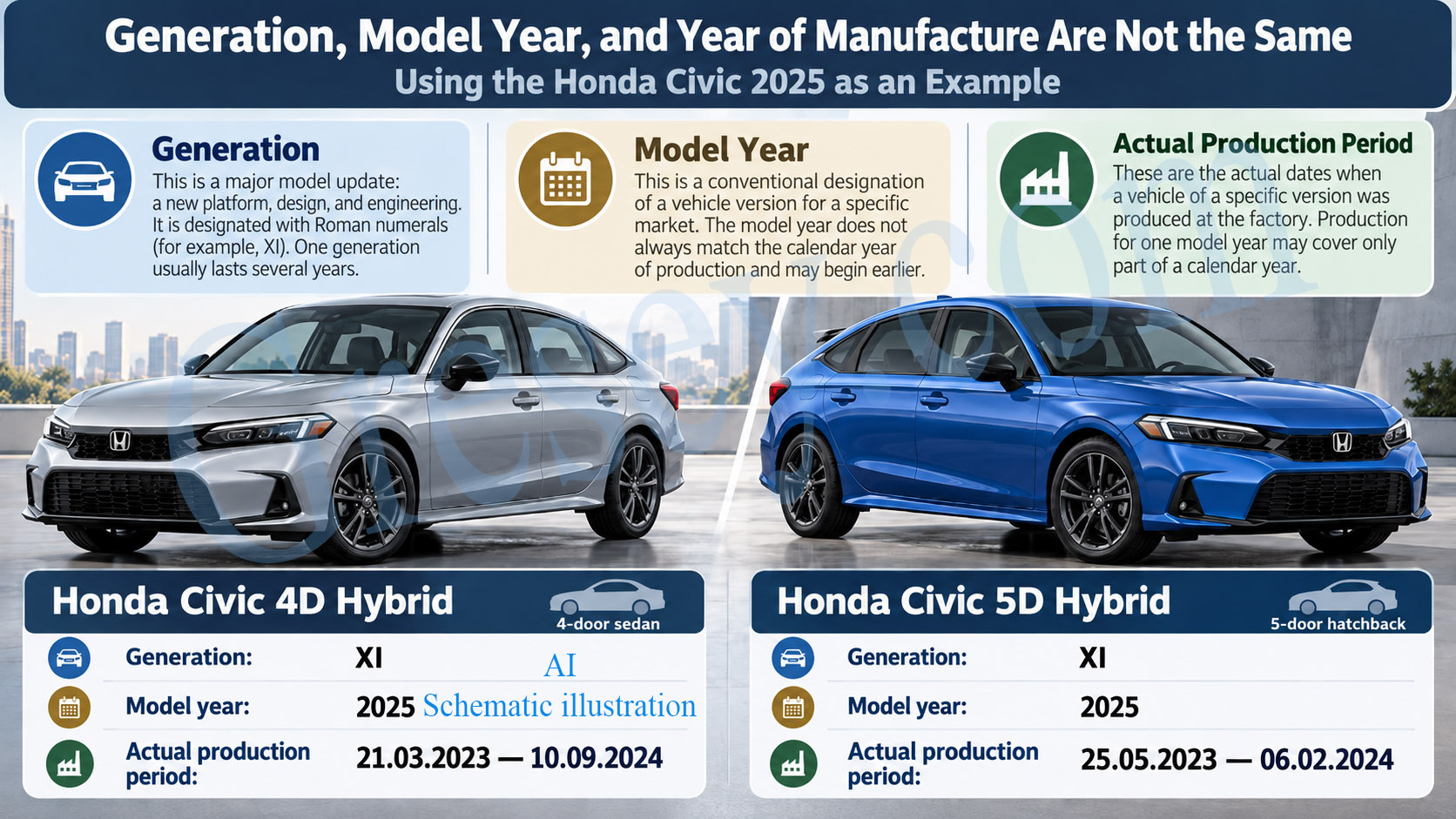
A Honda Civic generation groups vehicles belonging to the same major stage of development. Within a single generation, the model could remain in production for anywhere from one year to several consecutive model years. During that time, the manufacturer updated individual body styles, powertrains, and other components without completely redesigning the entire vehicle. The model year helps identify the position of a particular Civic more precisely within that stage. Vehicles from the same generation but different model years therefore differ from one another. Changes within a generation appeared gradually and depended on the specific model year.
In its North American chronology, Honda lists the model years when various Civic body styles and technical branches appeared. In its sales tables, the company reports data by calendar year. For comparisons, the official 2026 Digital FactBook is therefore the better reference.
When identifying a particular Honda Civic, the generation and model year should be considered rather than the production year alone. The generation indicates the vehicle’s overall stage of development. The model year helps determine which specific version within that stage a particular vehicle belongs to. The model year and the vehicle’s actual production year do not always match. The 2025 Honda Civic provides a clear example. Official NHTSA reports state that the 2025 Honda Civic 4D Hybrid was produced from March 21, 2023, through September 10, 2024. The 2025 Honda Civic 5D Hybrid was produced from May 25, 2023, through February 6, 2024. In other words, vehicles from the 2025 model year were actually manufactured in the 2023 or 2024 calendar year. [HC25][HC22][HC28]
What Was the Honda Civic Like in the 1970s?

According to Honda’s official chronology, the gasoline-powered 1973 Civic Hatchback was the first Civic to appear in North America. For eight years, it was the only model in the North American market. Honda’s chronology lists the Sedan only from the 1981 model year. The Wagon is also listed as a 1981 model. The 1973 Honda Civic can therefore be considered the pioneer in the development of the model family for the North American market. During this period, the Civic existed primarily as a compact gasoline-powered Hatchback. In the following decade, Honda began expanding the Civic with new body-style branches. [HC25]
How Did the Honda Civic Change in the 1980s?
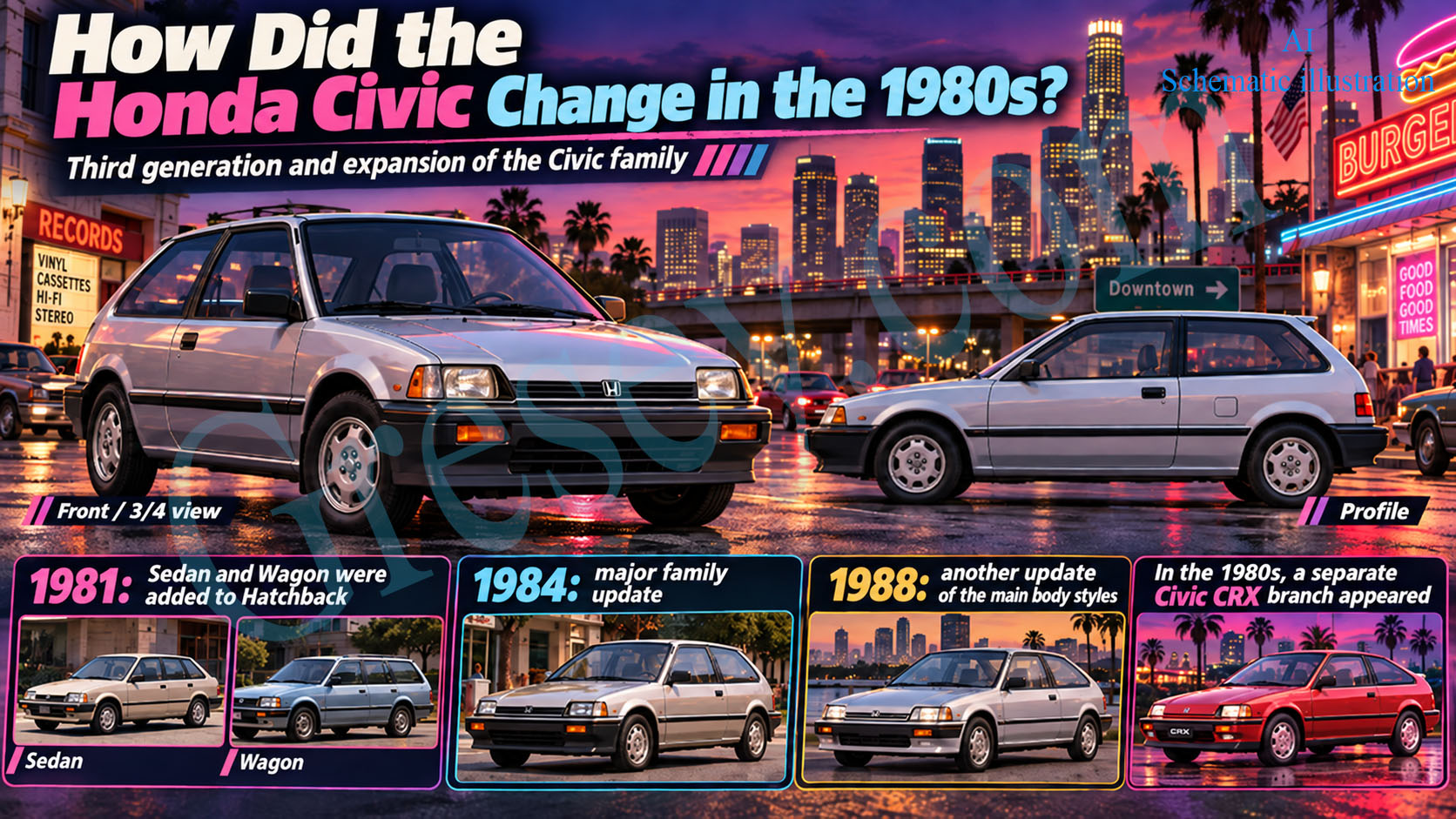
An updated Civic Hatchback entered the North American market for the 1980 model year. In the 1981 model year, the family expanded with the Sedan and Wagon. The next major update came for the 1984 model year. Honda updated the Hatchback, Sedan, and Wagon. At the same time, the Civic family gained a separate CRX branch. Honda introduced the CRX in 1983 as its first vehicle developed primarily for the U.S. market. The model was created in response to demand from American buyers for a vehicle with the highest possible fuel efficiency. Honda again updated the main Civic Hatchback, Sedan, and Wagon body styles for the 1988 model year. The 1988 Civic CRX also entered a new stage of development. Over the course of a single decade, the Civic expanded from one Hatchback into a family with several body-style branches. By the end of the 1980s, it included the Hatchback, Sedan, Wagon, and the separate CRX branch. [HC25]
What Did the Honda Civic Become in the 1990s?
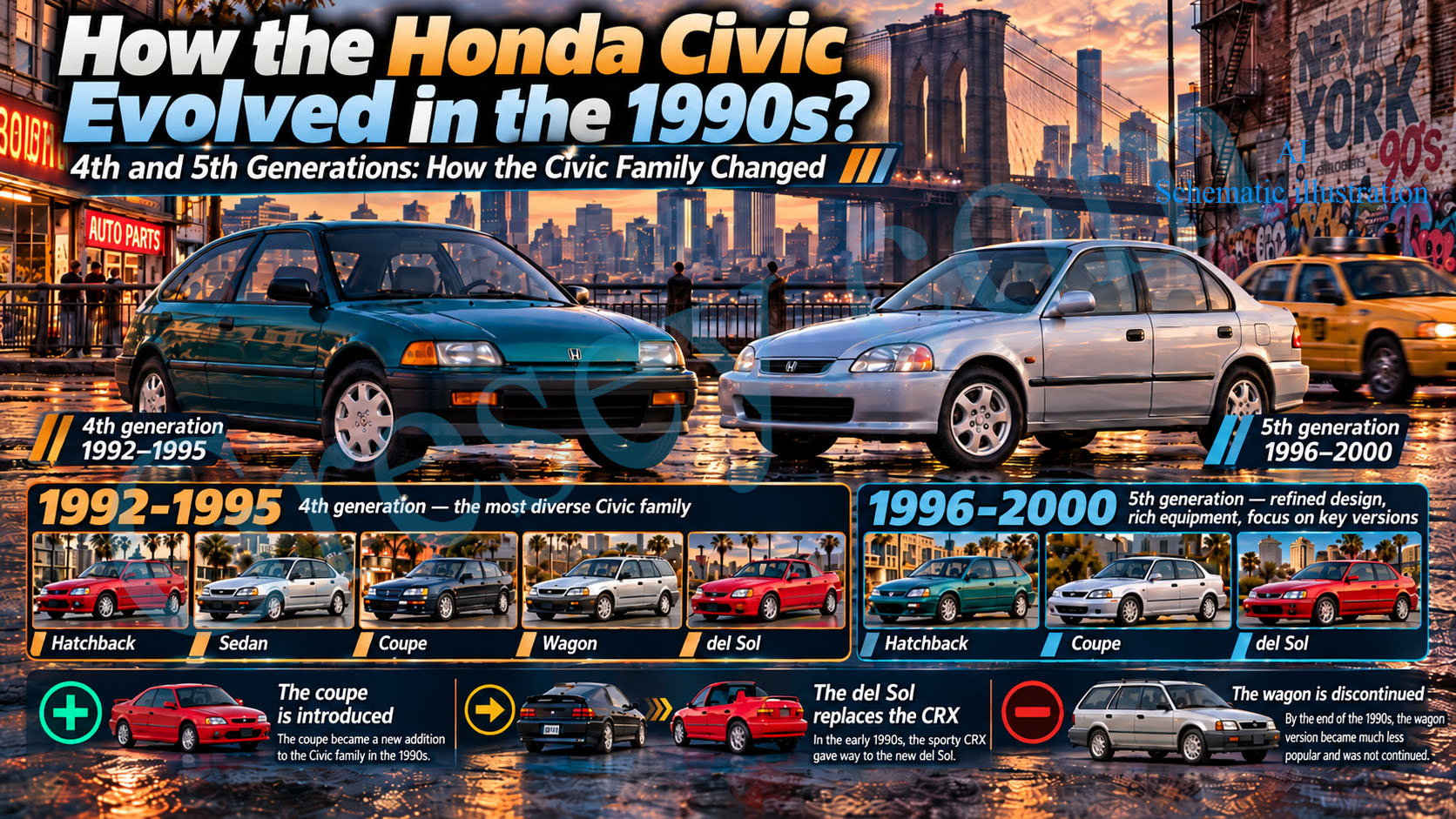
For the 1992 model year, Honda changed the Civic family’s body design, revised its powertrains, and updated the suspension and other major components. The Coupe received a new body design for the 1993 model year. The separate two-seat Civic Del Sol also appeared that year. It featured a removable roof panel and a sportier focus. The Civic received a more substantial update for the 1996 model year. Honda introduced 3-stage VTEC and the Honda Multimatic continuously variable transmission. These technologies improved the balance between performance and fuel efficiency. At the same time, the Civic family became more environmentally friendly. Five U.S.-built Civic versions received LEV certification in California and complied with EPA standards.
For the 1998 model year, Honda added a natural-gas-powered version to the Civic family. This gave the Civic a separate powertrain branch with lower harmful emissions than conventional gasoline-powered versions. Honda later called this version the Civic GX. It remained in the model line through the 2011 model year. The structure of the family changed at the same time. The Wagon, which Honda had offered during the 1980s, had disappeared from the North American Civic lineup by the 1990s. The CRX branch also did not continue beyond the 1988 model-year update. In 1993, the Del Sol took its place among the Civic’s separate two-seat models. [HC25][HC29]
How Did the Honda Civic Change in the 2000s?
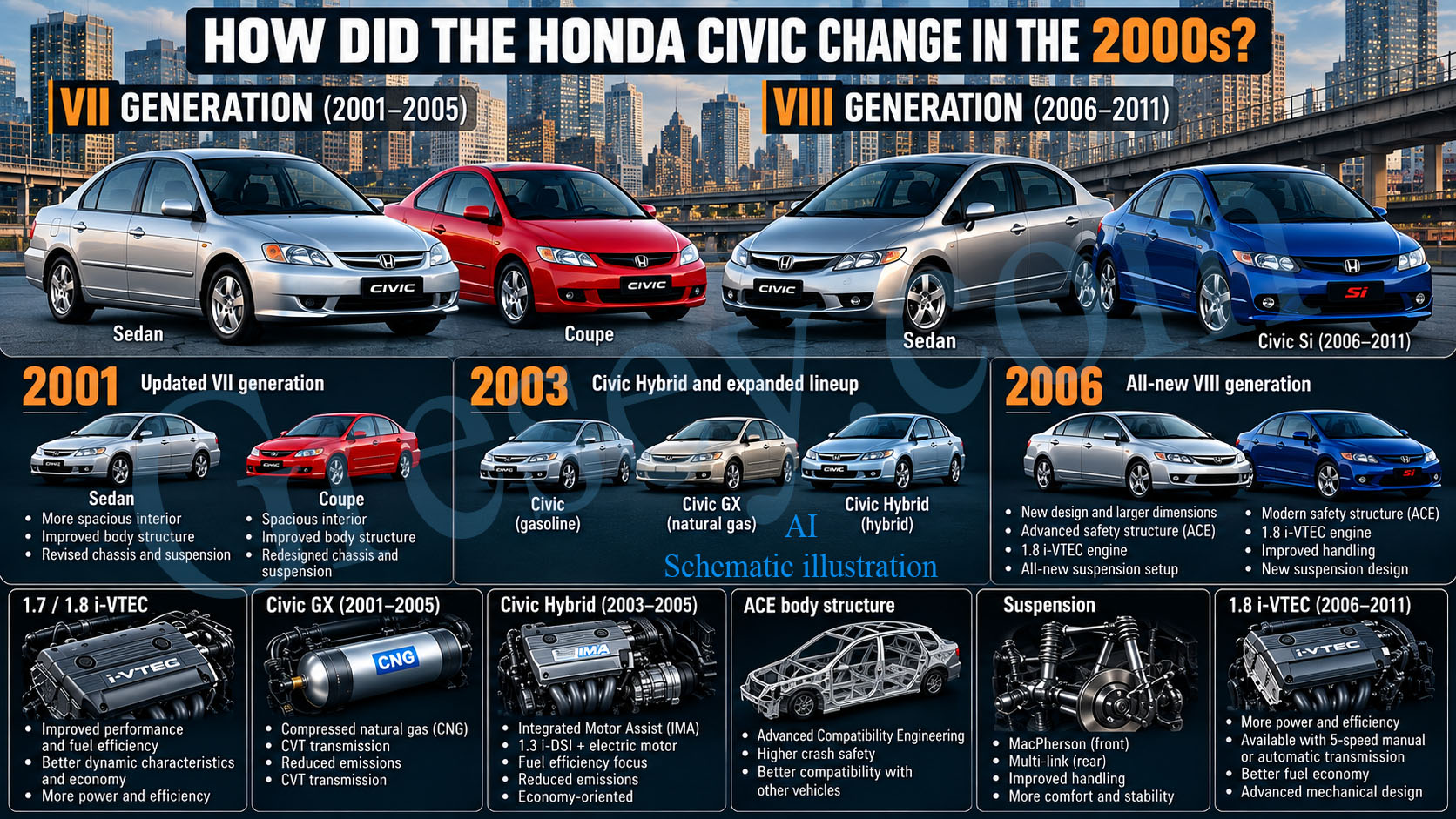
For the 2001 model year, Honda completely redesigned the Civic Sedan and Coupe. The vehicles received more spacious interiors, reinforced body structures, and redesigned chassis. In the body’s load-bearing structure, Honda replaced some conventional-steel components with equivalent high-strength-steel parts. This increased structural rigidity and improved crash-energy distribution. The Civic also received front seat belts with pretensioners, dual-stage front airbags, and side airbags. The natural-gas version entered a new stage of development. The 2001 Civic GX received a CVT, increased range, and improved fuel efficiency. A major change in the North American automotive market came for the 2003 model year. Honda introduced the Civic Hybrid with a 1.3-liter, four-cylinder gasoline engine rated at 85 hp and carrying the LDA designation. This gave the family a third powertrain branch, hybrid, alongside gasoline-powered vehicles and the natural-gas version.
For the 2006 model year, Honda introduced the eighth-generation Civic and completely redesigned the Sedan and Coupe. The vehicles became wider and lower, while the Sedan’s wheelbase increased. Honda also increased body rigidity and introduced the ACE structure, designed to manage crash energy more effectively. The changes also affected the chassis. Honda replaced the previous front suspension with a MacPherson-strut layout featuring revised geometry and installed a compact multi-link design at the rear. All versions received the Drive-by-Wire Throttle System. The steering column gained height and reach adjustment. Honda supplemented the conventional braking system with ABS and Electronic Brake Distribution. Honda equipped the Sedan and Coupe with a new 1.8-liter i-VTEC engine. For the Civic Hybrid, Honda revised the Integrated Motor Assist system. The IMA system gained improved energy regeneration and the ability to operate on electric power alone under certain conditions. The lineup also gained the sporty gasoline-powered Civic Si with a 2.0-liter i-VTEC engine and a six-speed manual transmission. [HC25][HC27]
How Did Honda Civic Generations Develop in the 2010s?
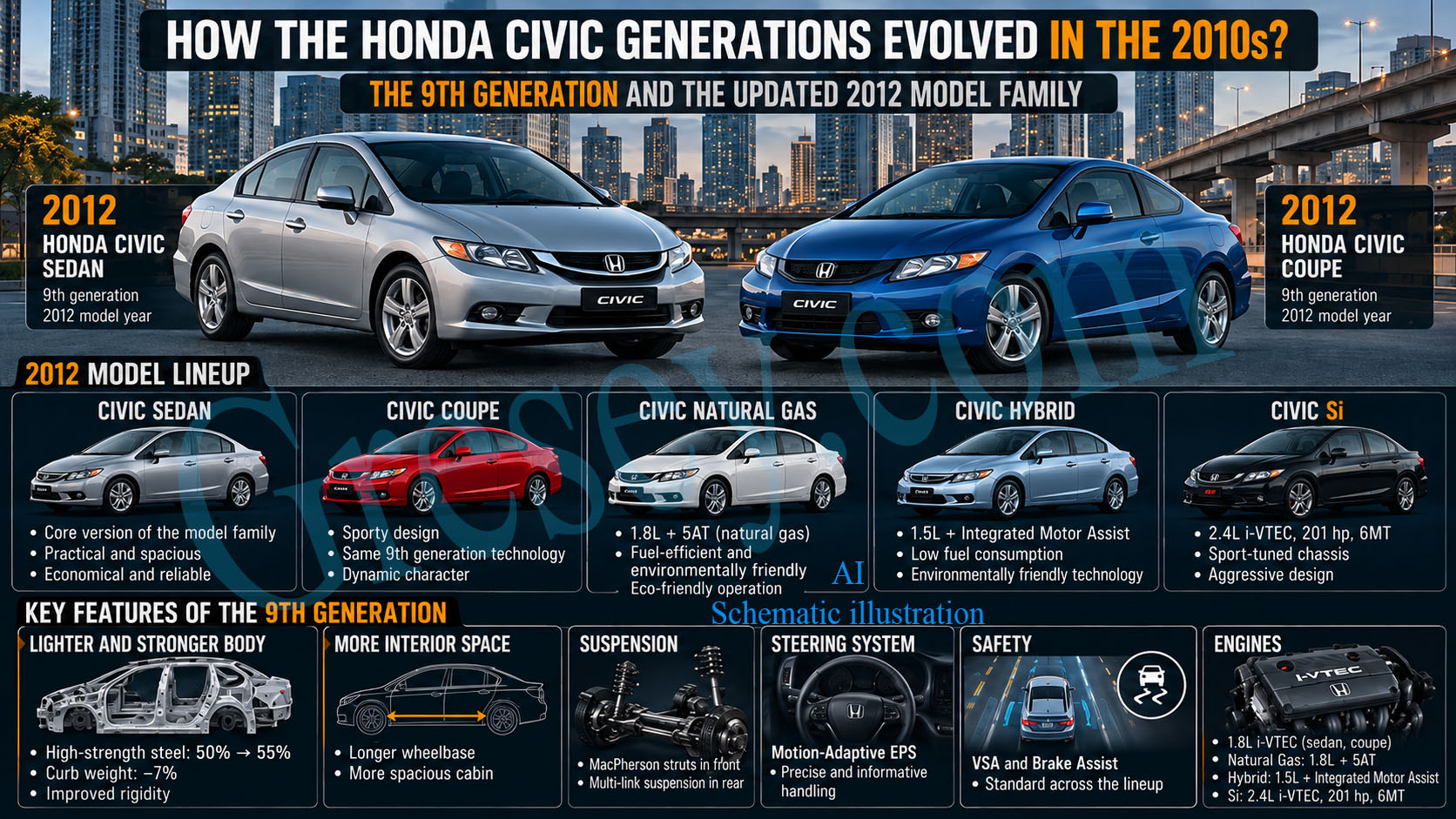
2012 model year. Honda introduced a new generation of the Civic Sedan and Coupe. The body became lighter and more rigid. In the Sedan’s structural components, the proportion of high-strength steel increased from 50 to 55 percent, while body weight decreased by about 7 percent. At the same time, its static and dynamic rigidity increased by approximately 10 percent. Honda slightly shortened the wheelbase, improving maneuverability while also increasing interior space. The Civic family retained a MacPherson-strut front suspension and a multi-link rear design. Honda redesigned individual front and rear suspension components to provide a more comfortable ride. In its road test, Car and Driver noted that the suspension had become softer. Road noise and vibration decreased. All versions received Motion-Adaptive EPS electric power steering. VSA stability control and Brake Assist became standard.
The main gasoline-powered versions retained the 1.8-liter i-VTEC engine, but Honda reduced mechanical power losses in the engine by decreasing friction between components. The Civic family also received further improvements in emissions performance and fuel efficiency. The Civic Natural Gas received an updated 1.8-liter engine and a five-speed automatic transmission. For the Civic Hybrid, Honda increased gasoline-engine displacement to 1.5 liters and revised the Integrated Motor Assist system. The sporty Civic Si also received major changes. Honda replaced the 2.0-liter engine with a new 2.4-liter i-VTEC rated at 201 hp and offering increased torque. The vehicle retained its six-speed manual transmission but received a sport-tuned suspension. [HC25]
How Did the Honda Civic Change as It Transitioned to Modern Generations?
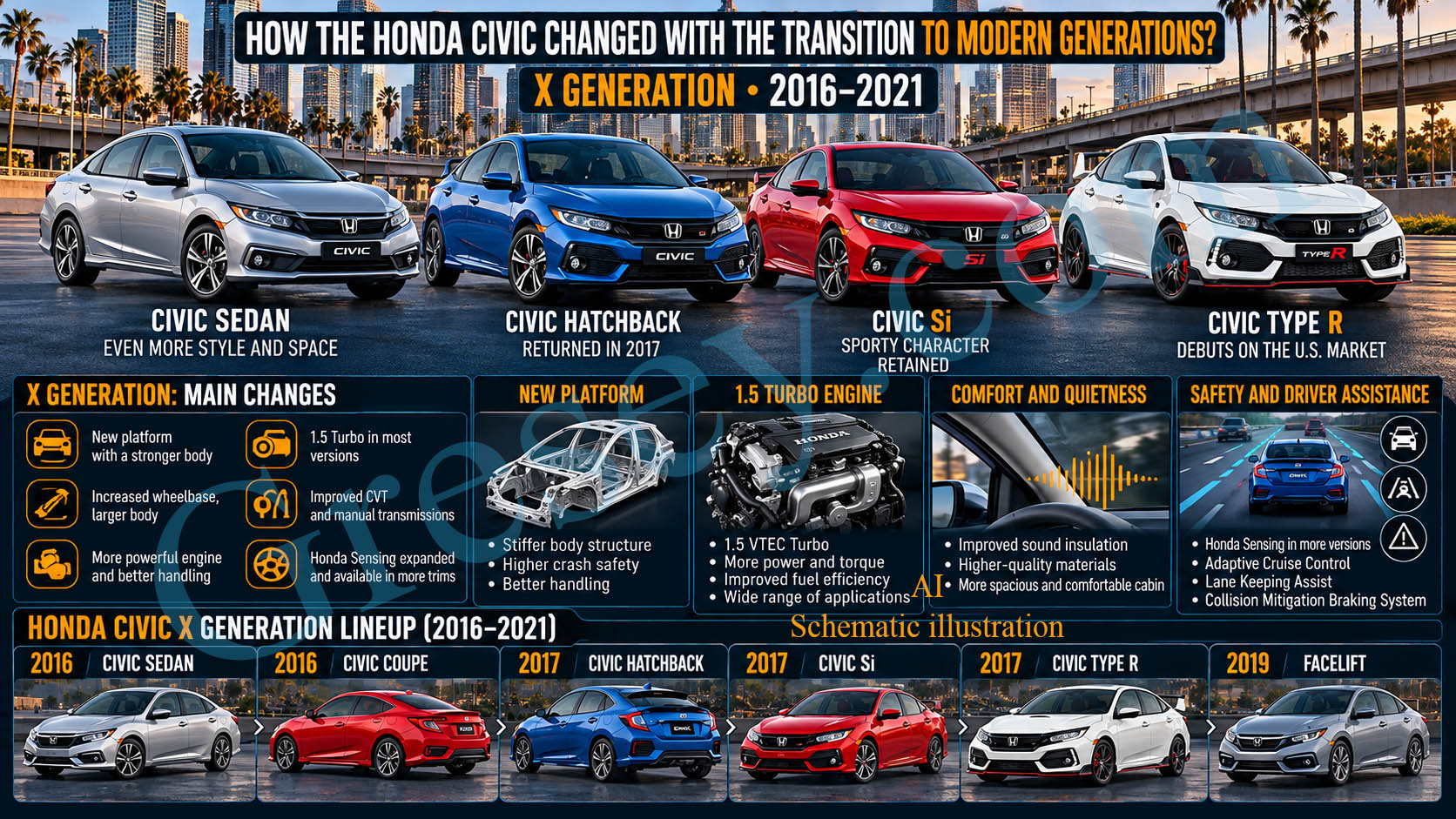
The year 2016 marked the arrival of the tenth-generation Honda Civic. For the 2016 model year, Honda introduced redesigned Sedan and Coupe models in the North American market. The vehicles received a different platform and a reinforced body. Honda lengthened the wheelbase further, widened the body, and lowered the vehicle’s overall profile. The lower profile made the Civic more stable on the road, while the interior became more spacious. The powertrain lineup also changed. Honda installed a new 2.0-liter gasoline engine in the base versions. More expensive models received a 1.5-liter turbocharged engine. Turbocharging allowed Honda to increase Civic power without moving to a larger-displacement engine. Compared with the previous generation, Honda significantly improved the Civic’s sound insulation. New body seals reduced air leakage into the cabin by 58 percent. The vehicle received an acoustic windshield, triple door seals, and denser engine-compartment insulation. Rear passengers gained 1.2 inches of additional legroom, while trunk capacity increased by 2.6 cubic feet.
The steering system received a variable ratio. This allowed the steering to respond smoothly to small steering inputs while changing wheel direction more quickly during larger steering movements. The Civic also gained Agile Handling Assist. In corners, the system applied braking to individual wheels, helping the vehicle follow the intended path more precisely. The Civic Hatchback returned to the North American lineup for the 2017 model year. Before then, Honda had not offered a new generation of the gasoline-powered Civic Hatchback in North America since the 1996 model year. After its return, the family once again included the Sedan, Coupe, and Hatchback. At the same time, Honda continued developing the sporty versions. The Civic Si remained in the model line, and the Civic Type R later arrived in North America. By the end of the 2010s, the Civic had become a broader lineup with several body styles and distinct performance-oriented branches. [HC25]
How Did the Honda Civic Change with the Transition to the Eleventh Generation for the 2022 Model Year?
For the 2022 model year, Honda introduced the eleventh-generation Civic in the North American market. This time, the changes affected the entire vehicle structure. Honda redesigned the body, chassis, interior, electronics, and suite of safety systems. A notable change appeared in the body layout. Honda moved the lower mounting points of the front pillars nearly two inches rearward and lowered the hood line. The exterior mirrors moved from the pillars to the doors. This created an additional field of view between each mirror and the front pillar. The horizontal viewing angle through the windshield increased from 84 to 87 degrees. The vehicle itself also received a longer hood and a less wedge-shaped profile than the tenth-generation Civic. Honda increased the wheelbase by 1.4 inches and widened the rear track by 0.5 inch. These changes increased body and cabin dimensions. The longer wheelbase gave rear passengers a more natural and comfortable seating position. Honda shortened the Sedan’s rear overhang by 1.4 inches. The lower section of the trunk opening became 5.3 inches wider. Larger items became easier to load through the wider opening, while the rear of the vehicle itself did not become longer.
The body’s structural design changed substantially. Sedan torsional rigidity increased by 8 percent compared with the tenth generation. Bending rigidity increased by 13 percent. The body flexed less during cornering and when traveling over uneven surfaces. This allowed Honda to tune the suspension and steering more precisely. The vehicle responded more consistently to driver inputs. Honda used approximately ten times more structural adhesive and fitted an aluminum hood to the North American Civic Sedan for the first time. The front subframe was also made of aluminum. This construction allowed Honda to strengthen the body without significantly increasing vehicle weight. Honda also revised suspension and steering behavior. Its engineers reduced friction in the ball joints, steering column, and shock-absorber mounts. In the rear suspension, Honda installed bushings with revised characteristics to adjust its behavior over uneven surfaces and in corners. The electric power steering received new feedback tuning. These changes affected how the vehicle responded to small steering inputs, changes in direction, and road irregularities. According to Honda, noise from sharp suspension impacts decreased by approximately 20 percent.
The basic engine configuration remained unchanged, but Honda revised how the engines operated. The naturally aspirated 2.0-liter engine remained the main engine for lower trim levels. The 1.5-liter turbocharged engine received a different exhaust-gas delivery system for the turbocharger and VTEC exhaust-valve lift control. Output in regular versions increased to 180 hp, while torque rose to 177 lb-ft. Honda also revised the CVT calibration. The transmission began lowering its ratio earlier during braking and gained more pronounced simulated shifts during hard acceleration. For the eleventh generation, Honda also changed the driver’s workplace. Base versions received a partially digital instrument panel and a 7-inch center display. Higher trim levels replaced the conventional instrument cluster with a 10.2-inch display showing speed, engine rpm, and other driving information. Honda placed a separate 9-inch infotainment display in the center of the dashboard. For higher-end versions, Honda added wireless Apple CarPlay and Android Auto, wireless phone charging, and a 12-speaker Bose audio system. At the same time, Honda retained separate conventional controls for frequently used functions.
The most extensive changes occurred in the safety systems. Honda Sensing replaced the previous camera-and-radar combination with a wide-angle camera and a more powerful processor. Its viewing angle increased from approximately 50 to 100 degrees. The system could recognize more objects and road boundaries. Traffic Jam Assist and Traffic Sign Recognition joined the feature set. Honda also revised the Adaptive Cruise Control and Lane Keeping Assist System algorithms. Honda also redesigned passive safety. The Civic received a new ring-shaped driver’s front airbag and a three-chamber front passenger airbag. Their design is intended to reduce head rotation in an oblique frontal collision. Honda added front knee airbags and rear-passenger side airbags. The total number of airbags reached ten. The transition to the eleventh generation did not change the Civic through a single new system or engine. Honda simultaneously redesigned the body structure, visibility, chassis tuning, driver interface, and safety-system architecture. [HC30]
What Changed in the Honda Civic for the 2025–2026 Model Years?
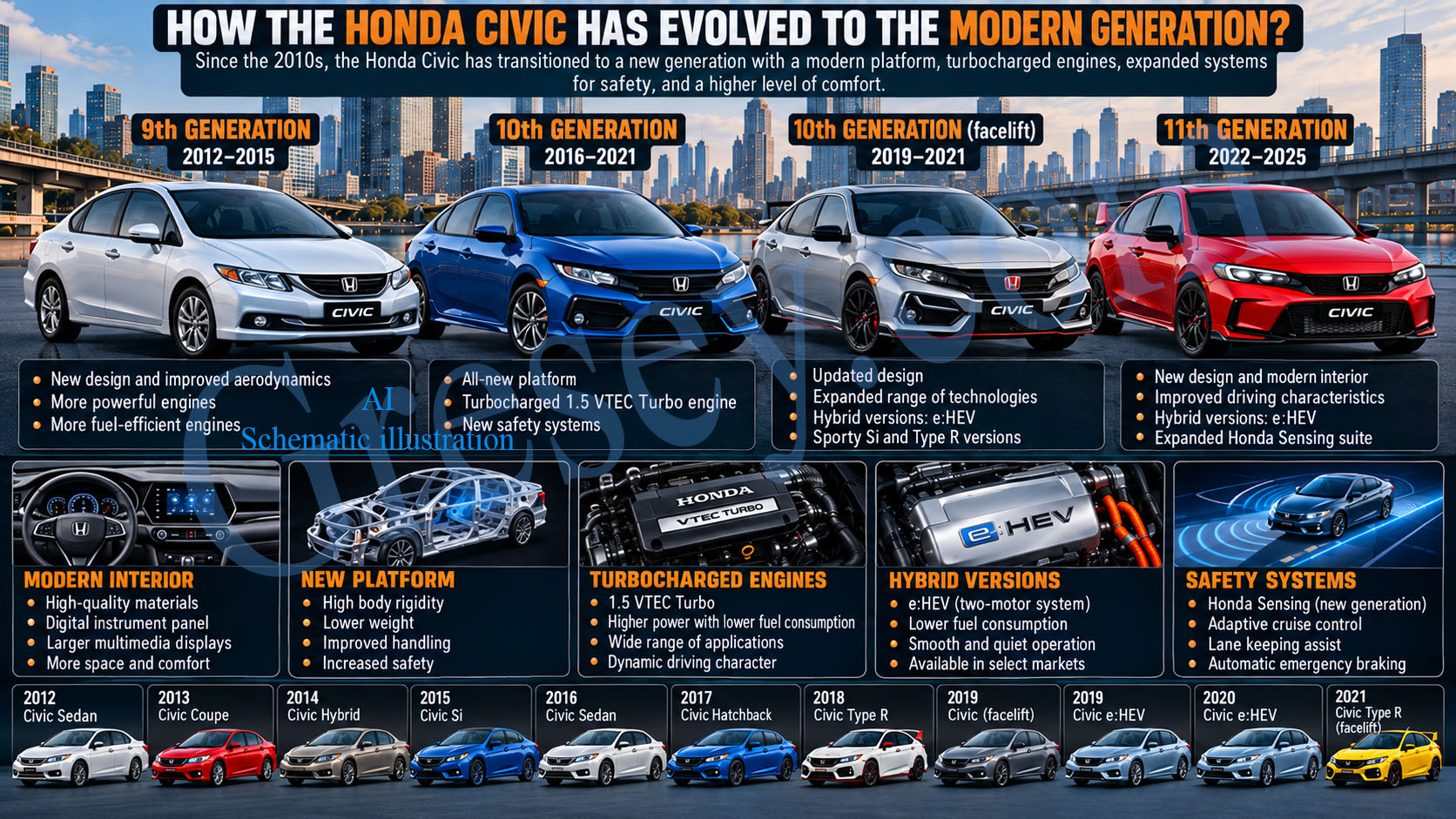
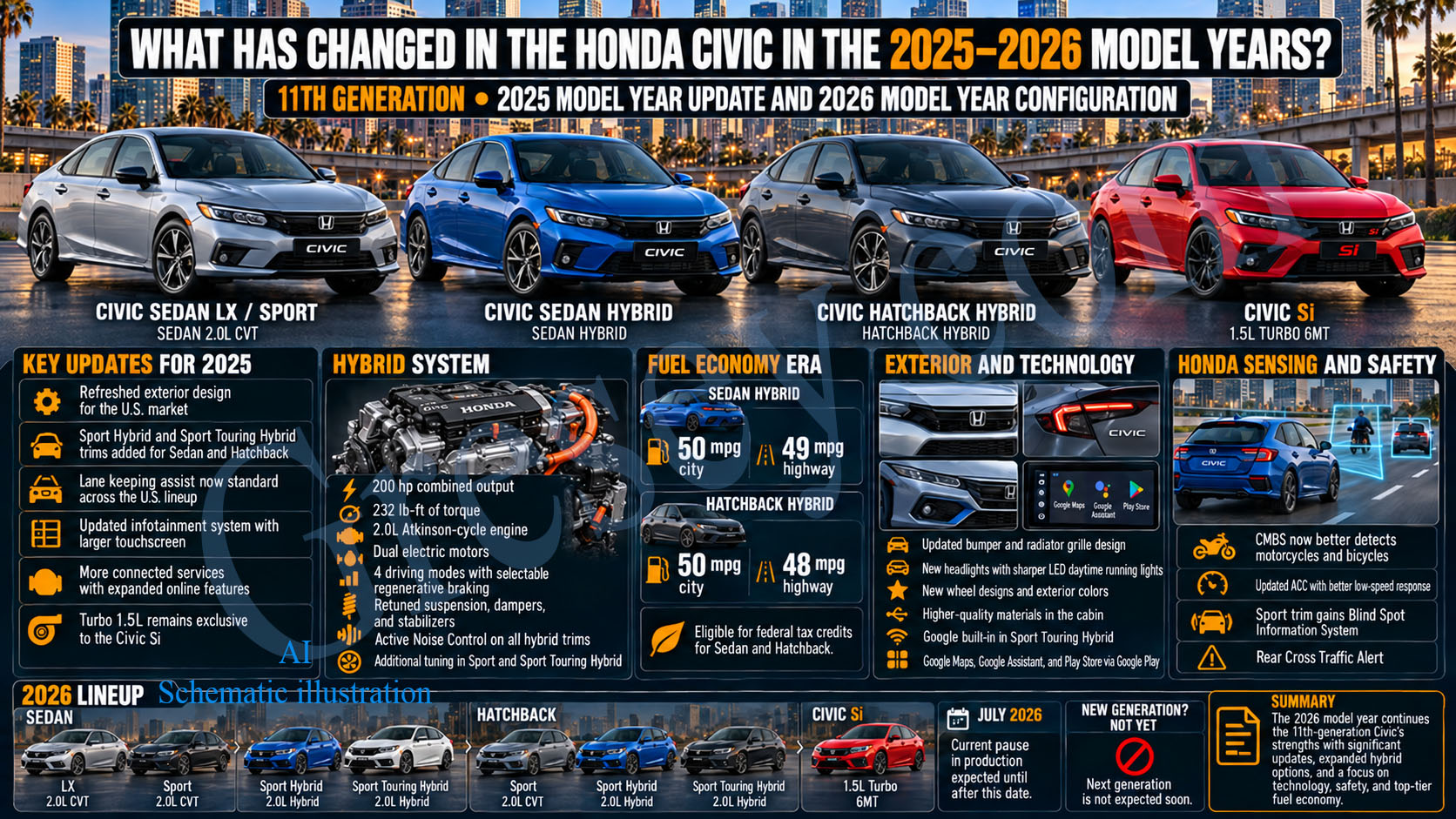
For the 2025 model year, Honda carried out a major update of the eleventh-generation Civic. The main change was the return of the hybrid branch to the U.S. Civic lineup. The hybrid powertrain became available in Sport Hybrid and Sport Touring Hybrid trims for both the Sedan and Hatchback. For the Civic Hatchback, this was the first hybrid version of the Hatchback body-style branch in the U.S. market. Honda also changed the structure of the regular model line itself. The previous EX and Touring versions with the 1.5-liter turbocharged engine gave way to the Sport Hybrid and Sport Touring Hybrid. The base LX and Sport retained the naturally aspirated 2.0-liter engine and CVT. Buyers of a regular Civic therefore now choose between a naturally aspirated gasoline-powered vehicle and a two-motor hybrid system. The turbocharged engine remained primarily part of the sporty Civic Si.
The hybrid powertrain produces a combined 200 hp and 232 lb-ft of torque. It combines a 2.0-liter Atkinson-cycle gasoline engine with two electric motors. For the driver, the changes affected fuel consumption and the vehicle’s deceleration characteristics. The Civic Hybrid received four levels of regenerative deceleration, selected with steering-wheel paddles. For the hybrid versions, Honda changed the suspension spring and shock-absorber tuning and selected different tires. All hybrids received Active Noise Control, while the Sport Touring Hybrid gained additional wheel resonators to reduce noise. Fuel consumption became another notable difference of the new powertrain branch. The Civic Sedan Hybrid received EPA ratings of 50 mpg in the city and 49 mpg combined. The Hatchback Hybrid received 50 mpg in the city and 48 mpg combined. The hybrid system did not require a separate body design or reduce the family to a single vehicle type. Honda integrated it into both the Sedan and Hatchback.
The 2025 Civic can be distinguished externally by its revised front end. Honda redesigned the bumper and grille. The Sedan received darker taillights. Hybrid versions gained their own front-end elements. All versions received front USB-C ports. For the Sport Touring Hybrid, Honda installed Google built-in in the Civic for the first time, including Google Maps, Google Assistant, and Google Play apps. The changes also affected Honda Sensing. The Collision Mitigation Braking System gained expanded motorcycle and bicycle detection capabilities, improving driving safety. Honda also revised the operation of Adaptive Cruise Control and the Lane Keeping Assist System. Sport versions received the Blind Spot Information System and Rear Cross Traffic Alert.
For the 2026 model year, Honda did not move the Civic to a new generation or carry out another major redesign. The Sedan retained the LX and Sport versions with the 2.0-liter engine, along with the Sport Hybrid and Sport Touring Hybrid. The Hatchback continued to be offered as the Sport, Sport Hybrid, and Sport Touring Hybrid. EPA ratings for these powertrains also remained at the levels established by the updated 2025 models. A separate change affected the sporty Civic Si branch. For the 2026 model year, Honda retained the Civic Si’s 1.5-liter turbocharged engine rated at 200 hp and its six-speed manual transmission. In July 2026, Honda announced that production of the current Civic Si would be suspended after the end of that model year. At the same time, the company confirmed that a new Si version is expected to return to the model line later. For the 2026 model year, the structure of the Civic family differs noticeably from the one with which the eleventh generation began in 2022. The main volume lineup is divided between conventional 2.0-liter versions and two-motor hybrid versions. The Civic Hybrid is available in both main body styles. Electronic functions have become part of the vehicle’s standard architecture. The 2025 update defined the Civic configuration with which the eleventh generation approached the end of its current stage of development. [HC31][HC32][HC33]
Honda officially uses letter designations exclusively to distinguish trim levels. Historically, however, specific meanings have become associated with them in American automotive culture. The LX designation, which once referred to the top Luxury trim, eventually became the base standard. The EX badge has traditionally been associated with Executive, or with a higher level of comfort and technology.
Abbreviations and Terms:
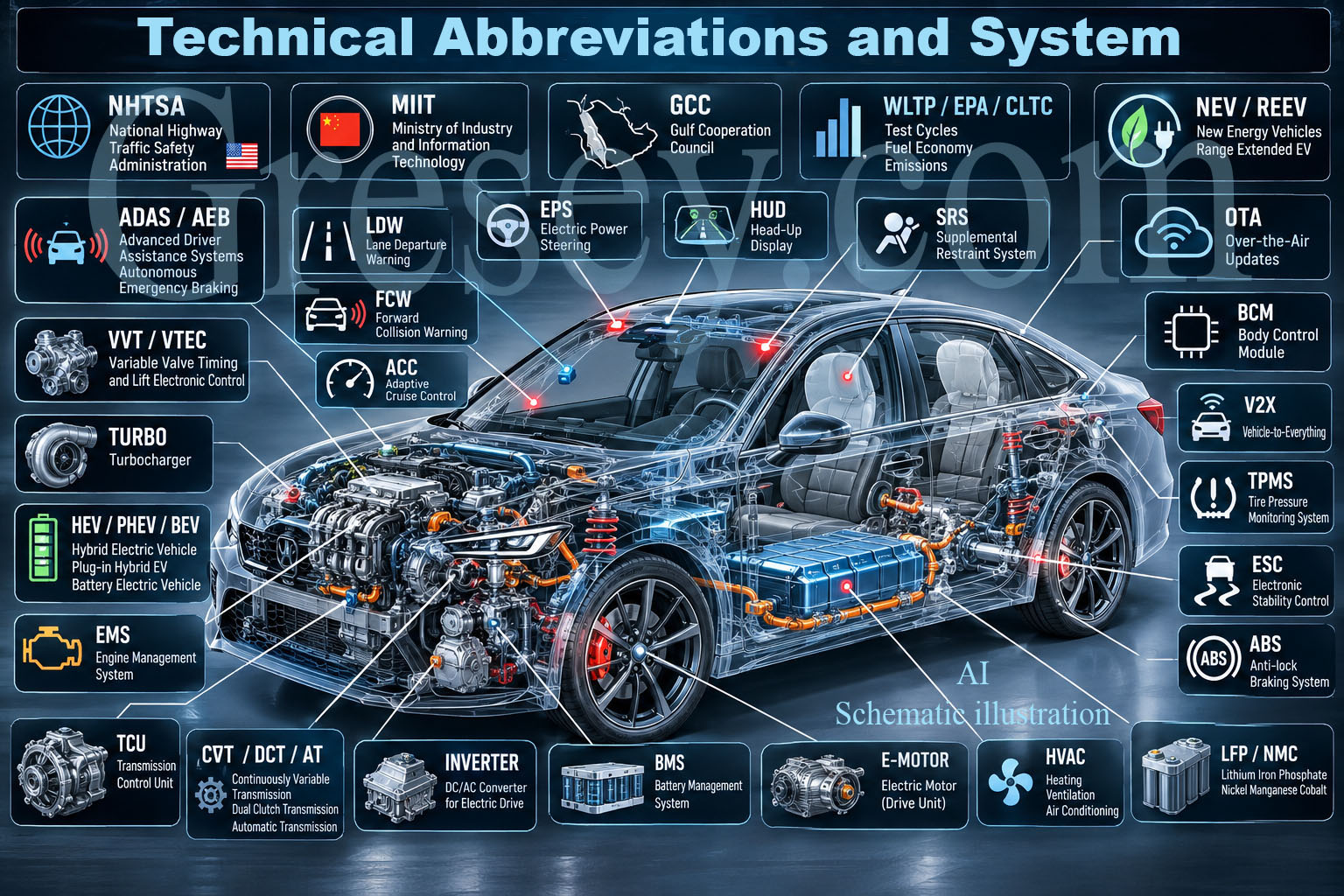
- CRX — Civic CRX — a two-seat, lightweight branch of the Civic family focused on efficiency and sporty driving.
- Del Sol — Civic del Sol — a two-seat Civic-based model with a removable roof panel.
- 3-stage VTEC — 3-stage Variable Valve Timing and Lift Electronic Control — a Honda valve-control system using multiple valve-operation modes to balance efficiency and performance.
- Honda Multimatic — Honda’s continuously variable transmission used on certain Civic models.
- LEV — Low Emission Vehicle — a vehicle certified to meet stricter emissions standards.
- EPA — Environmental Protection Agency — the U.S. agency responsible for emissions and fuel-economy testing and ratings.
- GX — Civic GX — the natural-gas-powered version of the Civic.
- CVT — Continuously Variable Transmission — an automatic transmission that varies its gear ratio continuously rather than using fixed gears.
- ACE — Advanced Compatibility Engineering — Honda body-structure technology designed to better manage and distribute crash energy.
- MacPherson — MacPherson strut suspension — a common independent front-suspension design using the strut as a structural suspension component.
- Drive-by-Wire Throttle System — electronic throttle control that replaces a mechanical throttle cable with electronic sensors and actuators.
- Electronic Brake Distribution — a system that automatically varies braking force between the wheels depending on load and driving conditions.
- i-VTEC — intelligent Variable Valve Timing and Lift Electronic Control — an advanced Honda valve-control system combining VTEC with variable camshaft timing.
- Integrated Motor Assist — Honda’s early hybrid system in which an electric motor assists the gasoline engine.
- Si — Civic Si — Honda’s sport-oriented Civic variant, positioned below the Type R.
- Motion-Adaptive EPS — Motion-Adaptive Electric Power Steering — Honda electric power steering that can provide steering input intended to help the driver maintain vehicle stability.
- VSA — Vehicle Stability Assist — Honda’s electronic stability-control system.
- Civic Natural Gas — a Civic version designed to run on compressed natural gas.
- Agile Handling Assist — a Honda handling system that can apply light braking to individual wheels to improve cornering response.
- Type R — Civic Type R — Honda’s highest-performance Civic variant.
- VTEC — Variable Valve Timing and Lift Electronic Control — Honda technology that changes valve timing and lift to improve performance and efficiency.
- Honda Sensing — Honda’s suite of driver-assistance and active-safety technologies.
- Traffic Jam Assist — a low-speed driver-assistance system designed to help with steering and lane positioning in congested traffic.
- Traffic Sign Recognition — a system that detects selected road signs and displays their information to the driver.
- Adaptive Cruise Control — cruise control that automatically adjusts vehicle speed to maintain a set following distance.
- Lane Keeping Assist System — a system that can provide steering assistance to help keep the vehicle centered in its lane.
- Atkinson cycle — an engine operating cycle designed to improve thermal efficiency, commonly used in hybrid powertrains.
- Active Noise Control — a system that uses the audio system to generate opposing sound waves and reduce unwanted cabin noise.
- Collision Mitigation Braking System — Honda’s automatic emergency-braking system designed to reduce the likelihood or severity of a frontal collision.
- Blind Spot Information System — a system that warns the driver when another vehicle is detected in a blind spot.
- Rear Cross Traffic Alert — a system that warns of approaching cross traffic while reversing.